
The Journey and Turning Points of Parasitology Research
Shinozawa:
Could you please tell us about your current work?
Kawazu:
I am researching diagnostic methods for schistosomiasis in Southeast Asia. Specifically, I conduct field surveys in countries like the Philippines to develop diagnostic tools that are tailored to the local environment. Schistosoma japonicum, which is prevalent in the Philippines, is a zoonotic infection transmitted through water buffalo and other animals used in rice paddies.
I also organize international exchange conferences among researchers from four Southeast Asian countries where schistosomiasis is endemic (including the Philippines and Indonesia) to facilitate information sharing. By promoting joint research and mutual cooperation toward the elimination of this parasitic disease, I help establish support systems for the self-sustained development of each country. Additionally, I am participating in a SATREPS project led by Dr. Hamano at the Institute of Tropical Medicine, Nagasaki University, where I investigate the relationship between animals and schistosomiasis in Kenya.
Shinozawa:
What was the motivation or background that led you to your current career?
Kawazu:
After graduating from the School of Veterinary Medicine at Kitasato University, I initially joined the Ministry of Agriculture, Forestry and Fisheries (MAFF) and conducted research on bovine protozoan diseases at the National Institute of Animal Health. Later, I obtained my PhD (Veterinary Medicine) from Hokkaido University and had the opportunity to study abroad at the Chicago Medical School. There, I studied under Professor K.P. Chang* and began research on Leishmania. That was my first experience with “medical parasitology”—the study of parasitic diseases in humans. You could say that was my first encounter with tropical medicine.
*Currently a Professor at Rosalind Franklin University (Chicago Medical School). He is a leader in research on the molecular biology of Leishmania, gene therapy, and the survival mechanisms of parasites within host cells.
Encountering Malaria and Challenging New Frontiers
Kawazu:
After returning to Japan, I spent about five years back at my original institute researching livestock parasites. Around that time, a research institute was established within the National Center for Global Health and Medicine (now the Japan Institute for Health Security (JIHS)). To strengthen infectious disease research, Dr. Shigeyuki Kano* moved from Gunma University to become the Director of the Department of Appropriate Technology Development and Transfer. Through an introduction from a mutual colleague, I had the opportunity to work seriously on malaria under Dr. Kano. I spent eight years there conducting basic malaria research and surveying drug-resistant parasites in the Philippines. Later, upon moving to Obihiro University of Agriculture and Veterinary Medicine, I shifted my research focus to Schistosoma japonicum, which was a major zoonotic issue in the Philippines.
*Currently Director of the Department of Tropical Medicine and Malaria, National Institute of Infectious Diseases, JIHS.
Shinozawa:
Was it difficult to pivot from malaria to Schistosoma japonicum?
Kawazu:
Since the primary field site was the same—the Philippines—I was able to work with the same collaborators, which made the transition relatively smooth. Furthermore, while schistosomiasis was a central theme of the Japanese Society of Parasitology 20 or 30 years ago, by the time I started, the focus of Japanese parasitic research had shifted heavily toward malaria. Consequently, there were very few researchers left in the field of schistosomiasis.
Shinozawa:
Was the fact that schistosomiasis had been eradicated in Japan a major factor in that shift?
Kawazu:
That was certainly part of it. Another factor was that the generation of professors who had studied schistosomiasis during its peak were retiring. Also, there was a “malaria research boom” about 20 years ago, so researchers naturally gravitated toward malaria, where it was easier to secure funding. Because of that shift, many things were left undone in schistosomiasis research. In that sense, I feel I’ve encountered many fascinating themes. Looking back, shifting from malaria to schistosomiasis was a positive turning point for me.
The Appeal and Challenges of Parasitology through a One Health Lens
Shinozawa:
What do you find most interesting or rewarding about your current work?
Kawazu:
Since Schistosoma japonicum is a zoonotic disease, measures targeting animals are essential. However, in the Philippines and Indonesia, this aspect remains largely untouched. Even in African schistosomiasis, attention has recently turned to the involvement of animals, such as infections in wild monkeys and the emergence of hybrids with livestock parasites. While the term “One Health”* has been around for a long time, I find great fulfillment in contributing to tropical disease control as an expert in animal infectious diseases. I also find the dynamic nature of parasitology fascinating—the ability to experience firsthand the emergence of new pathogens and the derivation of new life cycles.
*A concept that views human, animal, and environmental health as interconnected, requiring collaborative, cross-sectoral efforts to address challenges like zoonotic diseases.
Shinozawa:
On the other hand, what are the difficulties or challenges you face?
Kawazu:
Schistosomiasis was once a core theme of Japanese parasitology, but the number of researchers has decreased dramatically, especially among the younger generation. However, in the last few years, domestic and international expectations for Japanese schistosomiasis research have risen, and several large-scale projects are now underway. While I expect these projects to produce significant results and build strong networks with overseas researchers, I would be very happy if young Japanese researchers could inherit these achievements and develop them further.
Japan’s Responsibility and Contribution to Tropical Medicine
Shinozawa:
What is the significance of Japanese people being involved in and contributing to tropical medicine?
Kawazu:
We share a history with developing countries in Asia and Africa of struggling against outbreaks of various parasitic diseases, including malaria and schistosomiasis. I believe it is our responsibility—as the only country in Asia to have successfully eliminated these diseases—to take a leading role in parasitic disease control that threatens humanity. We also have a responsibility to pass down the wisdom of our predecessors who fought these diseases.
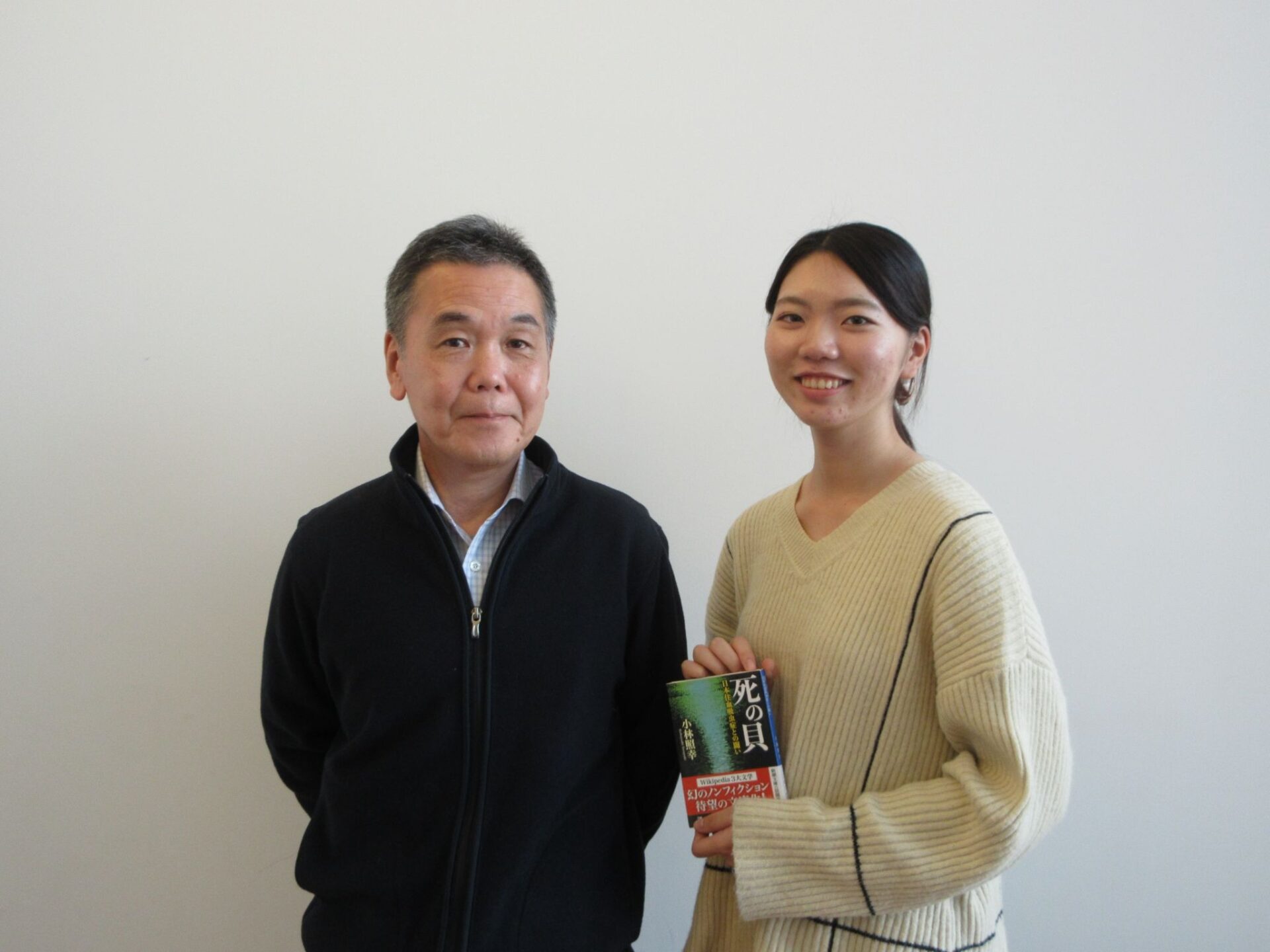
I often recommend the book Shi no Kai (The Shell of Death) to my students. It vividly describes the dedication of those who came before us and how they fought and eventually overcame schistosomiasis. I believe we must preserve and inherit the knowledge and wisdom of our predecessors.

Shinozawa:
Besides this book, do you have any other favorite words or people/works that have influenced you?
Kawazu:
I like what Dr. Takehiko Sasatsuki* told me when I was at the National Institute for Global Health and Medicine: “Always pursue the essence of things. It is simple, but I think it is a core teaching. I understand it as, “Pursue the goal, not the goal or the means. Whenever I am in doubt, I try to act in accordance with these words.
*Currently Professor Emeritus, Kyushu University; Distinguished Senior Professor, Faculty of Advanced Studies; Honorary President, National Center for Global Health and Medicine; passed away in 2023
The challenge of a declining number of researchers – Knowledge not passed on
Shinozawa:
In which areas of global health issues do you feel a sense of urgency?
Kawazu:
Among the relevant things in the world where I am now, what I feel a sense of crisis is that the number of young researchers of parasites, especially schistosomiasis, is really decreasing. As I mentioned earlier, Japanese schistosomiasis is a disease that was eliminated from Japan by Japanese people after they discovered many things about it. I believe that this is the most important disease to which Japan must contribute. However, there are very few young Japanese researchers who focus on this disease. I am very concerned about this.
In recent years, I have sensed that the international community has been placing greater expectations on Japan with regard to measures to combat this disease. This may be reflected in the fact that many major projects related to schistosomiasis have now been adopted. I am sure that we will see many results in the future. However, I am very concerned about whether this trend will be passed on to the next generation.
The Frontiers of One Health – Research Connecting People, Animals, and the Environment
Shinozawa:
What do you think of the one-health approach?
Kawazu:
I think the essence of One Health is communication. In short, in a team with various specialties, we must properly understand our own specialties, discuss in our own words what we can do and how we can contribute to the team, and understand each other. I think communication is important.
Shinozawa:
What are your future goals, dreams, and what you want to do?
Kawazu:
Now that I have retired from the line (I believe), I would be very grateful if you could entrust me with the role of supporting the work of all of you who are currently working on the subject of combating parasitic diseases such as schistosomiasis. I would be happy to help in any way I can with the experience and contacts I have cultivated so far.
Shinozawa:
Finally, do you have any advice or comments for the members of the Student Section of the Japanese Society of Tropical Medicine?
Kawazu:
Sometimes research topics that once went under the radar, such as the study of schistosomiasis, come back into the spotlight. I believe that important things never change, even if times change. This is a reflection on myself, but I think it is important to value my field of expertise and continue to persevere, even if things are tough right now.
Shinozawa:
Thank you very much.
Profile of Interview Participants
Dr. Shin-ichiro Kawazu
Originally from Saitama Prefecture. Graduated from the School of Veterinary Medicine, Kitasato University, and completed his postgraduate studies at the Graduate School of Veterinary Medicine and Animal Sciences, Kitasato University. He holds a PhD in Veterinary Medicine from Hokkaido University. After joining the Ministry of Agriculture, Forestry and Fisheries (MAFF), he served as a Director at the National Center for Global Health and Medicine (NCGM) Research Institute. In 2006, he was appointed Professor at the National Research Center for Protozoan Diseases, Obihiro University of Agriculture and Veterinary Medicine. His specialty is molecular parasitology.
Miku Shinozawa
Originally from Tokyo. Fourth-year student at the School of Nursing, International University of Health and Welfare (Narita Campus), majoring in Nursing and Public Health. She established the general incorporated association “Health for all.jp,” through which she engages in policy advocacy and awareness-raising activities for the three major infectious diseases. She aims to pursue epidemiological research in Africa in the future. Her current obsession is watching Indian films.